A Lineage of Ideas
The question of what men should eat to remain strong, alert, and capable has occupied human thinking for as long as recorded history allows us to trace. Long before the vocabulary of nutrients, metabolism, or biochemical pathways existed, cultures across the world developed elaborate frameworks — rooted in observation, tradition, cosmology, and practical necessity — for understanding the relationship between food and male vitality.
This article traces that lineage of ideas. It is a study not in prescriptions, but in how different epochs and civilizations constructed meaning around food and the male body. What emerges is a picture of remarkable continuity in certain themes, alongside dramatic shifts in the language and logic used to explain them.
Classical Antiquity: Humoral Theory and the Heating Diet
In the traditions of ancient Greece and Rome, the body was understood through the doctrine of the four humours — blood, phlegm, yellow bile, and black bile — each associated with particular qualities such as heat, moisture, cold, and dryness. Health was interpreted as a state of balance among these humours, and disease as an imbalance. Food played a central role in managing this balance: different foods were thought to possess inherent qualities that could warm or cool, moisten or dry the body.
For men specifically, the ideal physiological state was understood as warm and dry, in contrast to the cool and moist qualities attributed to the female body in these frameworks. Foods classified as warming — red meats, legumes, strong wines — were therefore associated with male vitality in Greek medical texts including those attributed to Hippocrates and Galen. Physical labour and athletic performance were inseparable from questions of diet in classical thought; the preparation of athletes for competition involved elaborate dietary regimens that were documented, debated, and refined across centuries.
The Physician's Pantry
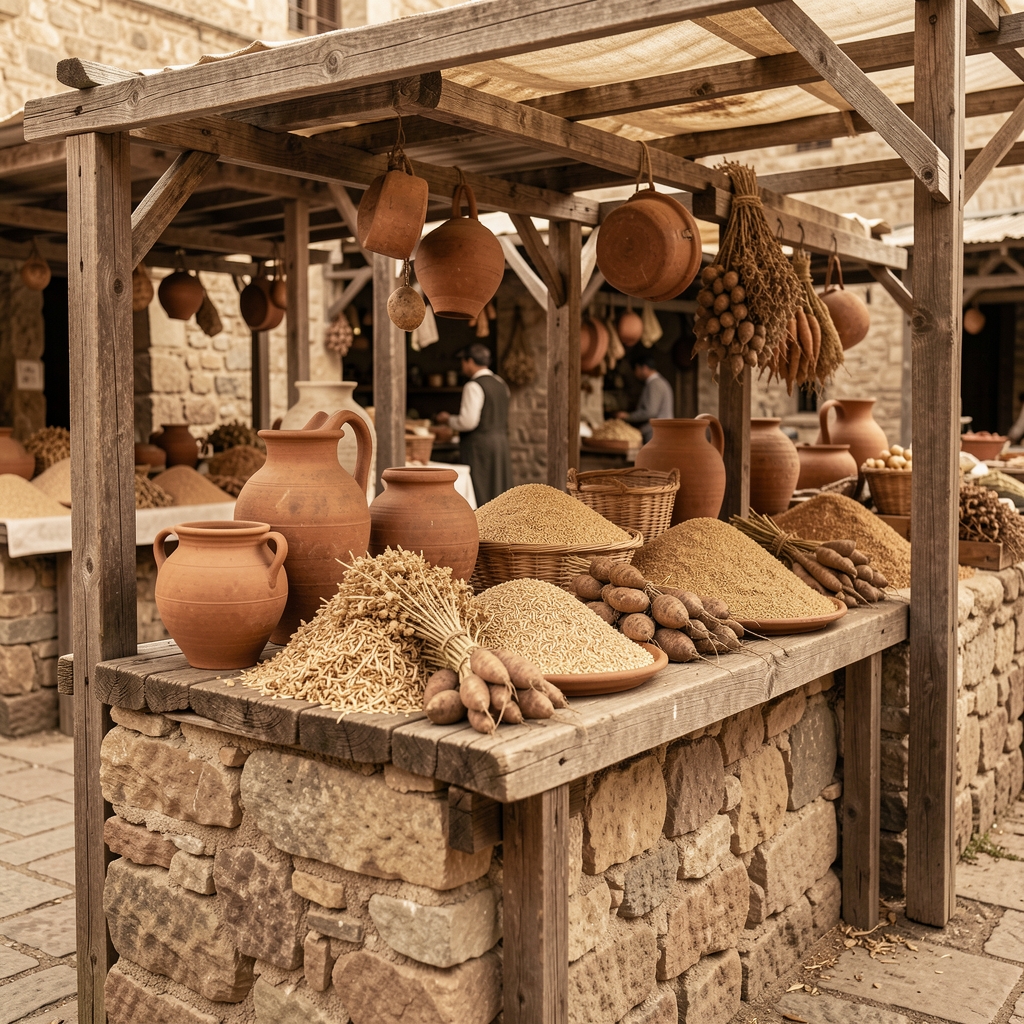
Classical Greek and Roman physicians compiled extensive lists of foodstuffs and their attributed qualities. Garlic, lentils, wheat porridge, and animal protein were among the staples prescribed for men engaged in physical training, organised within elaborate taxonomies of warming, cooling, binding, and loosening properties.
Elemental Balance in Eastern Traditions
In parallel with humoral thinking, Ayurvedic traditions in South Asia and classical Chinese nutritional frameworks developed comparable systems of classification. Foods were categorised by their energetic qualities and seasonal appropriateness. Male vitality was associated with the cultivation of vital essence, and dietary guidance was embedded within broader cosmological and philosophical frameworks.
Medieval Elaborations and the Regimen Sanitatis
The medieval period in Europe saw the transmission and elaboration of classical humoral frameworks through Islamic scholarship — particularly the encyclopaedic medical works of Ibn Sina (Avicenna), whose Canon of Medicine synthesised Greek and Arabic nutritional thought and remained an influential reference in European universities well into the 17th century. Dietary advice for men in these texts retained the emphasis on warming foods appropriate to the male constitution, while adding the influence of seasonal and astrological factors.
The Regimen Sanitatis — a genre of popular health guides produced in both learned and vernacular forms across medieval and early modern Europe — typically included detailed sections on diet as one of the "six non-naturals": air, food and drink, sleep and waking, motion and rest, retention and evacuation, and the passions of the soul. This framework is notable for anticipating the modern understanding that health arises from the interaction of multiple lifestyle domains rather than from diet alone.
The 19th Century: Vitalism, Protein, and National Strength
The 19th century brought both the early chemistry of nutrition and a powerful cultural linking of diet with national and racial fitness that is now deeply problematic but historically significant. Justus von Liebig, among the most influential chemists of the period, proposed a theory of nutrition centred on nitrogenous (protein) compounds as the primary driver of muscular work, with fats and carbohydrates playing supporting roles as fuel. This framework, though later revised, had a lasting effect on how the relative importance of macronutrients was conceptualised.
The Victorian era also saw the emergence of dietary reform movements — some secular, some religiously motivated — that debated the merits of meat versus plant foods for male energy and moral character. These debates were intertwined with anxieties about industrialisation, urban life, and the perceived decline of physical vigour. The arguments advanced were rarely limited to physiology; they encompassed economics, class, imperial ideology, and notions of civilisation.
The Vitamin Era and the Isolation of Micronutrients
The early decades of the 20th century produced one of the most significant paradigm shifts in nutritional science: the discovery that minute quantities of specific compounds — soon named vitamins — were essential for life and health. The identification of vitamins A, B complex, C, and D across the 1910s, 1920s, and 1930s fundamentally altered the framework through which nutritional adequacy was understood. It was no longer sufficient to consume adequate energy from protein, fat, and carbohydrate; the presence of specific micronutrients became recognised as a distinct requirement.
For the question of male nutrition specifically, this era produced research on the role of various micronutrients in male physiological processes that laid groundwork for ongoing scientific investigation. The vocabulary of nutritional science — deficiency, adequacy, recommended intake — became established during this period and remains the dominant framework today, though it has been increasingly supplemented by the study of dietary patterns and their aggregate effects.
Contemporary Frameworks: Patterns, Populations, and Complexity
Contemporary nutritional science has moved substantially away from single-nutrient thinking toward the study of dietary patterns and their relationship to population-level health outcomes. Epidemiological tools have expanded the evidence base enormously, though they have also made clear the considerable difficulty of isolating the effects of diet from the hundreds of other variables that influence human health over time.
What historical survey reveals is that the desire to understand the relationship between food and male vitality is deeply human and extraordinarily persistent. The specific vocabularies change — from humours to macronutrients to metabolic pathways — but the underlying questions remain remarkably stable. This continuity suggests that the topic is genuinely important to how human societies organise and understand themselves, and that any current framework, however sophisticated, is likely to be refined by those that follow.